In 2021 I realized that my diachronic analyses of Ravenloft would only be complete when they incorporated Boris Karloff’s character in The Mummy (1932). Having recently watched this and several other pertinent films, I am approaching the point where I am ready to state my case. But before I get there, I have to talk about Harley Quinn.
The fixation to be unfolded here arose decades ago, in an era in which I knew more about Harley Quinn than most people—an era in which there was considerably less information to be known about her. In more recent years, the character has slipped permanently out of my grasp, but in a manner that only confirms my thesis. I think. Let’s find out.
I am duty-bound to tell you first what you already know: Harley was invented for Batman: The Animated Series (1992). In her first appearances, she existed only as arm candy for the Joker. As the series progressed, a character emerged: She was a devoted moll, charismatic enough to match the most charismatic of Batman villains—but the Joker mistreated her—but she couldn’t help but love him—but she could also countenance a repressed-Sapphic partnership with Poison Ivy when their stars aligned. Mad Love (1994) revealed that Harley was originally Harleen Quinzel, the Joker’s psychologist.
Mad Love was one of the comics set within the continuity of Batman: The Animated Series. Up until a certain point, Harley was not depicted in any other “universes”—unlike Batman and the Joker, who each can be said to be “different people” in different shows and comic titles and films. It’s true that this sort of distinction is ultimately frivolous, but it might be instructive to notice that, for the first few years of her existence, there was only one version of Harley Quinn.
And it is fitting that the image that serves as one bookend of my fixation was the cover of the comic that introduced Harley to the “primary”/“canonical”/“real” Batman continuity, Batman: Harley Quinn (1999). The painting is by Alex Ross:
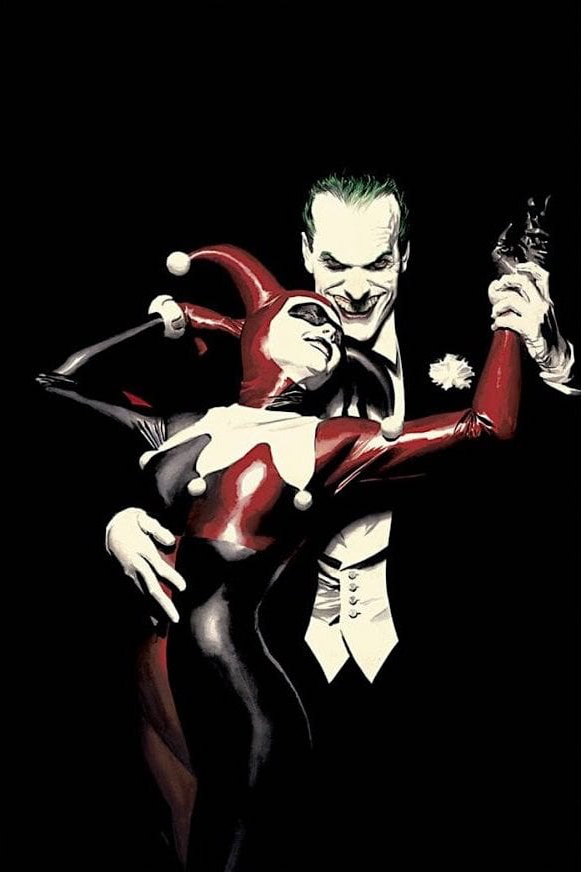
Plenty of people have seen this image without ever turning one page of the comic. Like me, for instance! I know this image primarily in the context of edgy dudes circa 2010 posting it on their Facebook walls, opining that the poster and his girlfriend are two of a Hot Topic kind, perfectly matched because they’re both so demented—or is it that they’re the only two people who see how demented the world itself is?
Well, I tell a lie. I know this image secondarily in that context, more by reputation. I know the image primarily from seeing people complain about those edgy dudes, pointing out that the Joker is actually an abuser and Harley Quinn is actually a victim and actually there is nothing to admire or emulate in their relationship.
And here is my gripe, the counter-whinge that I’ve been gnawing on for so many years: Harley Quinn isn’t actually anything. In any given continuity, in any given issue or episode of any of various series, her history and personality and decisions are at the whim of whoever’s writing the script this week. One depiction may overrule another by way of canonicity at the present moment, but we acknowledge this privilege is subject to be overturned by the next Crisis event or subtler retcon—which is ignoring the fact that this privilege is illusory in the first place, because Harley Quinn does not exist.
My complaint with the complainer is a failing of empathy. That edgy dude’s Facebook post was meant to convey some kind of meaning. He had something real to say about himself and his girlfriend, and to say it, he used this painting of thoroughly unreal criminals as a visual shorthand. He made those characters mean whatever he intended at the time, which is just what every author of a Batman story does, what every artist does: “I feel X, and I will say it with Y.” But you refused to understand him. You insisted that some other narrative was the only valid truth, that Harley Quinn can only mean one thing.
Let’s see how that panned out.
(Ideally this would go without saying, but lest I be misread I should stipulate: this refusal to understand, this insistence on monosemy, this technique of misreading so as to establish that the text is wrong, so the misreader gets to be right—these deficiencies are symptoms I must identify to illustrate a larger point. I am using Harley Quinn, or the saga of my fixation with Harley Quinn, as an illustration.)
I say “circa 2010,” but I really can’t pin down when I started chewing on this problem I had with this objection to these Facebook posts that used this image of this cartoon character. I can say with certainty, though, that it was before Margot Robbie’s performance Suicide Squad (2016). Harley’s metamorphoses were already underway: She had become something of an antihero in her solo comic appearances, significantly more kid-friendly in DC Super Hero Girls (2015), somewhat less so in Batman: Arkham Asylum (2009). But Robbie made Harley into a movie star. Into a Halloween costume! The character crystallized around Robbie’s performance—but just for a moment, since a sociopath defined by her codependence with Jared Leto is only marketable up to a point. Harley would need to be remade, and remade, and remade…
But by this point the character had definitively gotten away from me. I know her now only by her reputations. With a little research, though, we should be able to establish who Harley Quinn is:
Usually, we find her at some point along the narrative established by her DC Animated Universe incarnation. The Joker seduces his psychologist, makes her his henchwoman, rewards her loyalty with abuse; she escapes the relationship and falls in love with Poison Ivy. If her career goes on long enough, she follows a general descent from “insane criminal” to “sort of crazy antihero” to “wacky hero.” (The contradiction of a lovable villain can only survive so long in a serial medium.)
But many Harley stories depart from this pattern significantly. In The Batman (the 2004 cartoon), the Joker’s treatment of Harley is toned all the way down. In her few appearances, we seem to have more of a “good-natured” understanding of mutual unreliability, the “look how disturbed we both are; what a cute couple!” dynamic that those edgy dudes on Facebook were evoking. In Batman: Caped Crusader (2024), Harley has no connection to the Joker. Rather than transitioning from psychology to villainy, she executes her villainy with psychiatric techniques. Lady Gaga’s Harley in Joker: Folie a Deux (2024) is a fellow patient to the Joker, not a psychologist. Their relationship is unhealthy to say the least, but not abusive in the DCAU mode. Once Arthur Fleck abandons his canonical pattern, Harley can hardly cling to hers.
DC Super Hero Girls is the name of two series, with two distinct Harley Quinns. Both series are aimed at teens and tweens, populated by teenaged characters, so in the 2019 TV series the Joker cannot be out-and-out abusive. The worst we can call him qua boyfriend is “manipulative,” and anyway he only appears in a few episodes, emerging from the shadows of Harley’s backstory. Harley, in her civilian persona as Harleen Quinzel, is besties with Batgirl’s Barbara Gordon, and her arc is necessarily one of turning from villainy to heroism.
In the 2015 web series, the pre-Lauren Faust DC Super Hero Girls, Harley is a hero to begin with, or a hero-in-training: She’s the designated class clown at Super Hero High. The Joker is not her boyfriend; he is not a character in this series. This Harley shows no inclinations, so far as I can tell, toward a career in mental health treatment or a romance with Poison Ivy (a fellow hero-in-training). There are no traces of the classic, “canonical” Harley Quinn narrative here, and yet this is inarguably Harley Quinn—we can tell from her costume and how wacky she is.
Besides being “the funny one,” Harley Quinn’s position in the original DC Super Hero Girls lineup seems to be “the one without super powers, I mean, the other one, besides Batgirl,” and this brings me to another image, the opposing bookend of my obsession. I found it on the DC Super Hero Girls website in 2016. (Why was I browsing the DC Super Hero Girls website in 2016, you ask? Click here to learn about my obsession with the evolution of Harley Quinn.) Each of the central cast members had a gallery of avatar-ready 1000×1000-pixel JPGs, mostly just depicting cool super hero girls looking cool. Only one image had what you might call an inspiring message attached:
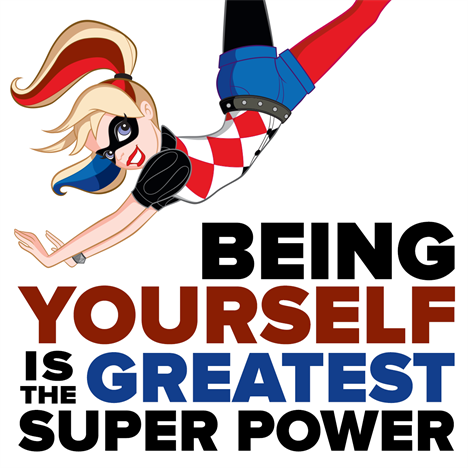
On most levels of interpretation, the sentence “being yourself is the greatest super power” is a meaningless platitude. In the context of a school full of teens with literal super powers, it is more than a little absurd. But when associated with Harley Quinn, with this plucky, empowering role model version of Harley Quinn, the sentiment is so arresting as to lodge itself permanently in my brain. How can we ask this girl to be herself? What is “yourself” when you are Harley Quinn?
She is not her relationship with the Joker, or her renunciation of same. She is not Arleen Sorkin’s vocal performance. For a while, you might say she was a costume. Later, it would become more accurate to say was that she was a color scheme, and now even that would require qualification. She is usually blonde, usually evil, usually ditzy, usually funny, usually insane; all these qualities appear and disappear at the writer’s convenience. The decades have proven what those edgy dudes on Facebook knew all along: Harley Quinn is whatever we want her to be.
(Why should we endow those edgy dudes with the same powers of meaning-creation as Paul Dini, Bruce Timm, Margot Robbie, Lauren Faust, et al? Well, here is the point on which I cannot hope to convince you. If your critical dogma places those powers solely in the hands of the artist, or solely in the hands of the audience, you are wrong, but I don’t know how to prove otherwise. I can tell you that artists and audiences are just people, that art is just a baroque form of communication, that communication is always a two-sided process of meaning-creation—but if you’ve been taught differently, I don’t expect you to believe me.)
As you have pointed out several times while reading this, the same basic facts are true of the Joker, of Batman (overwhelmingly so), and of Mickey Mouse, Sonic the Hedgehog, Abraham Lincoln, any character who via franchise or analysis or fan fiction becomes reframed and repurposed enough times. But even this is drawing too narrow a circle: The polyvalence/polysemy of Harley Quinn is that of any symbol. If we insist on one interpretation, we deny (or attempt, vainly, to abolish) the meaning-creating powers of art, which are the powers of language, of communication.
And now I can talk about Boris Karloff in The Mummy.