Category Archives: prose

2021 Year in Review

I love making things. I feel I am my best self when I am creating something. Do you feel the same way? How interesting.

But if you used this blog to keep up with all the things I make, you would get the impression that I never make anything (and may in fact be dead). Let’s correct that. Let us, in the middle of 2024, do my 2021 Year in Review.

My 2020 Year in Review is here.

And my 2021 Year in Review is HERE.

A Facebook post from 2011

Just thought I should put this somewhere more accessible.

Came across something interesting my my research…

It appears that famous murderer Lizzie Borden actually killed many more people than popular wisdom suggests. In fact, after “giving her father forty-one whacks,” she went on to murder her sister, Emma Borden—the deed evidently requiring forty-two blows from the very same axe. Then, in the same evening (really the early hours of the next morning), Lizzie accosted the family maid, Bridget Sullivan, hacking her forty-three times before jumping into her four-poster bed and falling asleep, her clothes still covered in blood.

Lizzie, now the sole inheritor of the Borden estate, was arrested and jailed on August 11, 1892. Before she could be tried for the quadruple homicide, however, her case was taken up by Thomas Embling, a psychiatrist who had gained fame for his involvement in a Parliamentary inquiry at the Yarra Bend Asylum. Embling managed to have Lizzie released under his supervision.

Just as Embling had predicted, Lizzie’s first act after her “escape” was to murder another maid, striking her with an axe forty-four times. Embling continued to observe this depraved behavior for several months before he was “whacked” himself, fifty-six times, by the object of his unseemly research. Embling’s experiment thus concluded, Lizzie was finally apprehended and returned to the custody of the Crown.

Embling was, thankfully, the last to fall to Lizzie’s axe, but it is interesting to note that if the waif were allowed to continue her string of murders, by today (July 8, 2011), she would have slain her 552,898,543rd victim, striking him or her 552,898,582 times.

You can read more about Thomas Embling in the Wikipedia article about him: http://en.wikipedia.org/wiki/Thomas_Embling
A through J: A Diachronic Survey of Other Places in Barovia

I have analyzed Location K84, the infamous Catacombs of Castle Ravenloft, in its several incarnations. It occurred to me that I would like to do a similar reading of the other parts of the castle. (Here that is.) But, as I started doing that, I started doing a similar reading of the whole adventure leading up to the castle. Which is probably not as exciting as the castle itself.

WHOOPS!

Some Etymologies in The Legend of Zelda: A Link to the Past

A sentence on Zelda Wiki posits that “Sahasrahla may be named after the seventh chakra of Hinduism, Sahasrara.” Sahasrahla, it goes without saying, is the wise old man who guides your quest in the early sections of A Link to the Past. His name, it goes without saying, is weird.

When we see sentences like these, it is wise to be skeptical. There’s no obvious reason for Sahasrahla to be named after a chakra, and the author of the sentence offers no support for the supposition. But it is not wise to conclude on this basis that the theory is incorrect. It is not wise to dismiss an idea out of hand just because at face value it seems goofy. Wise people are aware that the objective world, the world of facts, is extremely goofy.

Continue reading

K84: A Diachronic Survey of Ravenloft’s Catacombs

In this post we will look at the crypts in Castle Ravenloft and see how they changed from edition to edition.

Here’s a different post about locations in Barovia outside the castle. Here’s a third post about the castle itself.

Unnecessary Abstract Introduction (JUST SKIP THIS SECTION PLEASE)

Perhaps you have heard somewhere the idea that all stories—sitcoms, epic poems, video games, This American Life vignettes—are fundamentally retellings of older stories. Perhaps you have even heard the idea itself multiple times. In some contexts, the proposition refers to deep underlying structures to which storytellers inevitably return. This is a rich subject for analysis—but the big money is in abandoning all but the merest pretense of originality and casting the same characters in the same conflicts in the same settings that the audience remembers from 30 or 10 years ago. And this might be a good subject for analysis too. I hope.

This practice of story-rehashing is especially salient in the stories of Dungeons & Dragons, many of which are embodied in physical locations with detailed maps. The most successful D&D settings and stories are reprinted decade after decade, edition after edition, so that new players can enjoy the same adventures so beloved by their forebears, and old players can whine about the things that got changed.

I believe the paradigm example of this is Castle Ravenloft, depicted in the modules I6 Ravenloft (1983), RM4 House of Strahd (1993), Expedition to Castle Ravenloft (2006), and Curse of Strahd (2016). All four of these books tell basically the same story: “Go to this spooky castle and kill this evil vampire.” The vampire is always menacing the same young women; the aged fortune-teller always helps you find the same artifacts that will help you slay him. And in all four books, the floor plan of Castle Ravenloft is presented in basically the same form. This is fascinating, but not surprising: Nerds, who are humans, naturally hate change. Also, the original dungeon is very good. Why would you change it? Why indeed.

Continue reading

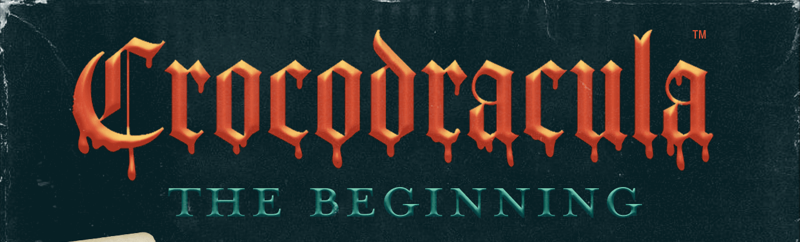
Uncovered! CROCODRACULA: THE BEGINNING

You can play this game right now! But you should probably find out where it came from first:

A few months ago, I came into the possession of a copy of a very old, very rare text adventure game. I happened to be poking around in—Well, maybe I should start from further back.

THE STORY SO FAR

A few years ago, I came into the possession of a copy of a very old, very rare text adventure game titled Crocodracula: What Happened to Calvin. Feeling an obligation toward the preservation of an oft-overlooked art form, I—

—Actually, I should go back even further.

Continue reading

The Imitable Process of Ryan Veeder: Additional Autosaving Techniques for Inform 7

There are a few more things I should say about implementing autosaving in Inform 7. In the previous posts I neglected to address how these techniques interact with the default verbs UNDO, SAVE, and RESTORE, which was a bit of an oversight. I’ll get around to that now, and then I’ll show you a couple of other neat things you can do with autosaving.

Continue reading

The Imitable Process of Ryan Veeder: Advanced Autosaving in Inform 7

In a previous post I explicated the basic principles of how to automatically track and restore the player’s progress in an Inform 7 game. What it really comes down to is this:

  • Represent the parameters of your game’s progression in a table.
  • Whenever the player does something worth autosaving, record it in that table, and then write that table to an external file.
  • When play begins, read that external file and use those data to reconstruct the player’s progress.

I said we’d get into some ways of representing progress in a nonlinear game. The first thing that comes to mind is my game The Lurking Horror II: The Lurkening, in which the player character learns various spells that let you manipulate the environment and solve puzzles. Learning certain spells requires you to learn certain other spells first, but the “tech tree” has enough branches that we can’t predict in what order the player will discover everything.

Continue reading

The Imitable Process of Ryan Veeder: Basic Autosaving in Inform 7

Ryan Veeder’s Authentic Fly Fishing autosaves your progress! This is kind of noteworthy, at least in the realm of text adventures. I don’t think Ryan Veeder’s Authentic Fly Fishing is the first text adventure to autosave your progress, but it might be the first game to do it in Inform 7.

Why bother with this feature for this particular game? Well, it was kind of necessary to make another feature work: Ryan Veeder’s Authentic Fly Fishing also uses the real-world date for certain “real-time” elements. The game can’t really keep track of these elements (say, counting how many different days you’ve played) if players are able to “change history” by loading outdated save files.

But there’s another reason, one which may more likely be applicable to your own personal design interests: Ryan Veeder’s Authentic Fly Fishing is supposed to be an extremely casual experience. There is no urgency for the player to reach the ending. (There is no ending.) It’s not supposed to be a battle of wits between the author and the player. You’re meant to visit the world of Ryan Veeder’s Authentic Fly Fishing for however long you want, whenever you feel like it, and maybe you’ll make some “progress” by finding something new, or maybe you won’t. It’s supposed to be very chill.

Requiring players to manually save their state at the end of a play session and then restore their state the next time they show up (being careful not to restore an old file and lose progress!) would detract from the casual experience I wanted to create. So it was doubly important for me to take the burden of progress management off the players’ shoulders.

Maybe you’d like to do something similar with your own Inform 7 project. Here’s how you can do that!

Continue reading